
This report was published July 7, 2026, and updated July 15 to reflect additional Q2 recall data released by NHTSA after the end of the quarter.
The BizzyCar Q2 2026 Recall Report examines another high-volume quarter for U.S. automotive recalls, as manufacturers continued to navigate complex vehicle systems, large multi-model campaigns, and safety issues affecting millions of drivers. While recall volume eased slightly from Q1’s record-setting pace, Q2 still saw more than 11 million vehicles recalled, making it one of the highest-volume quarters in recent years.
Q2 demonstrated that elevated recall activity is not limited to a single type of defect or repair method. Unlike Q1, which was heavily influenced by one exceptionally large electrical system campaign with over-the-air update eligibility, Q2 recall volume was spread across a broader mix of powertrain, structure, steering, tire, air bag, seat belt, and advanced safety system issues. Many of the quarter’s largest campaigns involved physical components, drivability concerns, or occupant safety systems.
This report highlights the brands, components, and campaigns that defined Q2 2026, while examining how sustained recall volume, shifting component trends, and the limited role of OTA updates are shaping recall management for manufacturers, dealerships, and drivers.
Q2 2026 Recall Report Highlights
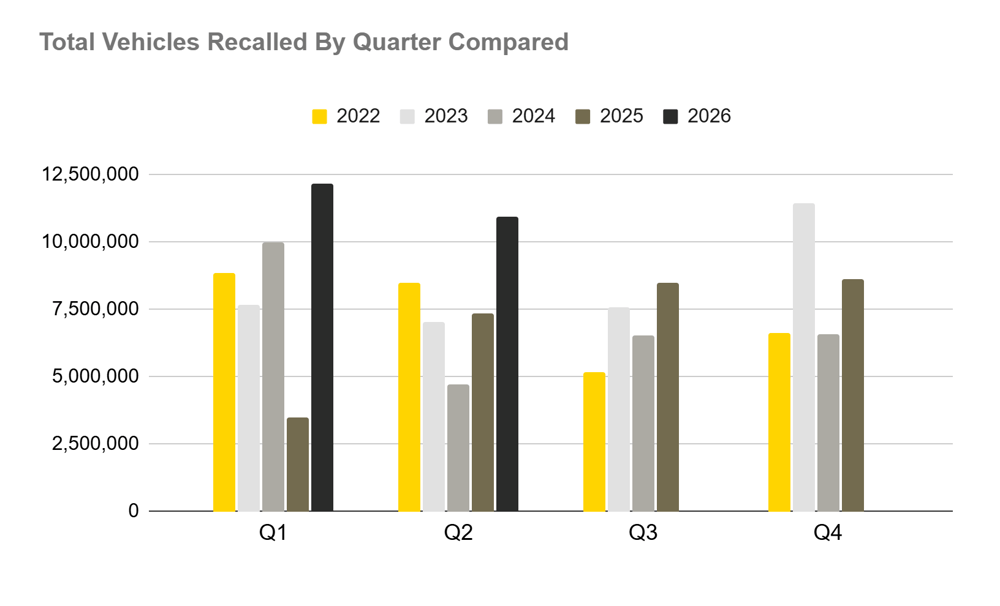
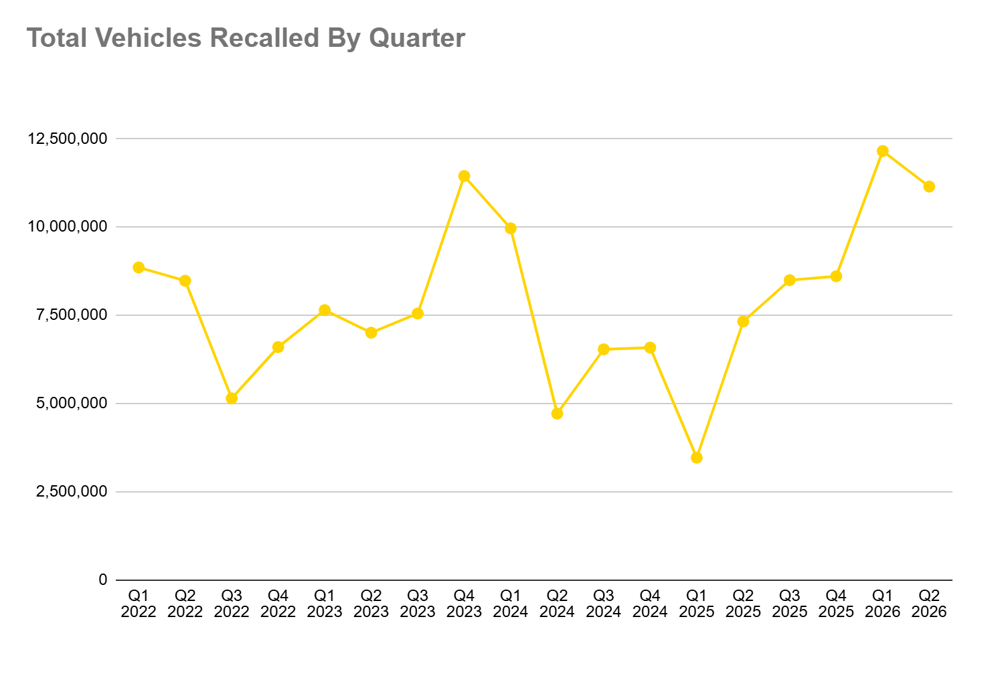
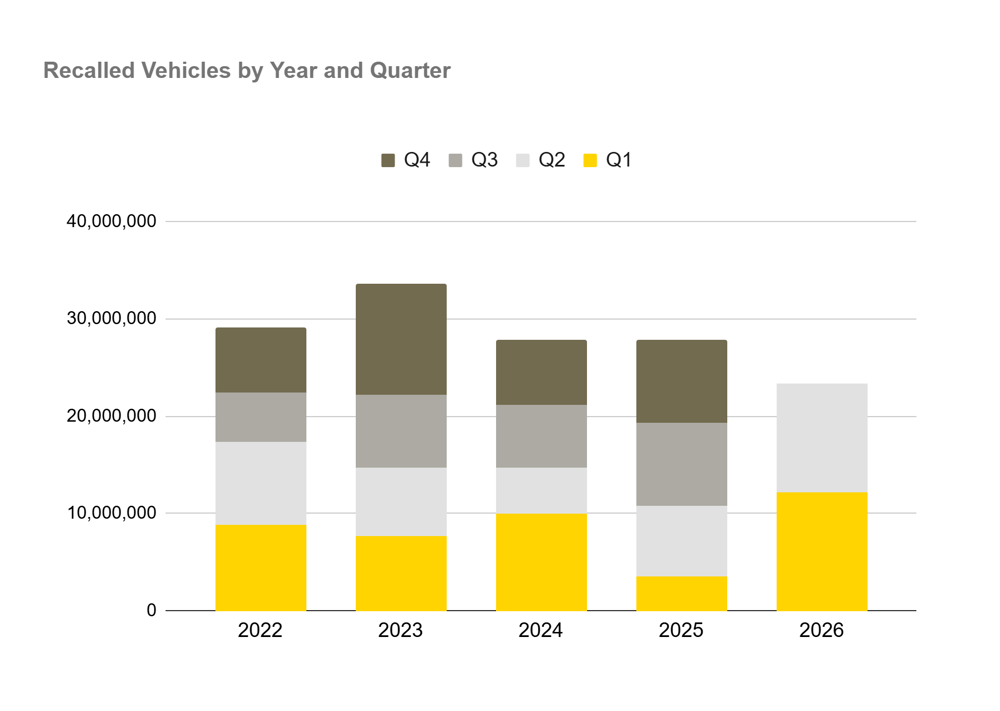
Q2 2026 saw approximately 11.1 million vehicles recalled, the third-highest single-quarter total in recent years. Only Q1 2026, at 12.2 million vehicles, and Q4 2023, at 11.4 million vehicles, were higher.
Vehicle Recalls Are Up Significantly in 2026
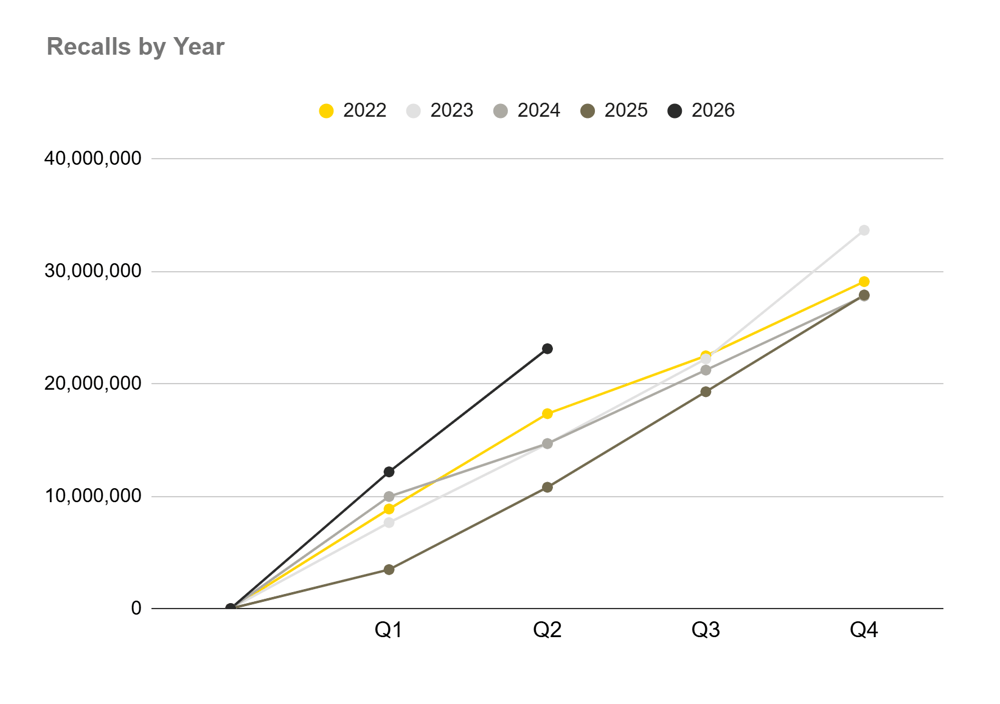
Q2 recall volume rose nearly 50% year over year, continuing the sharp acceleration seen at the start of 2026. Through the first half of the year, manufacturers recalled over 23 million vehicles, more than double the total from H1 2025 and about 33% higher than the next-highest first half since 2022.
Recall Volume Was Less Concentrated Than in Q1
Q2 recall activity remained historically high, even without a single campaign approaching the size of Ford’s Q1 26C10 recall, which affected more than 4.3 million vehicles. Q2 volume was spread across multiple large campaigns and a wider mix of components, including power train, structure, air bags, steering, tires, seat belts, and fuel systems.
OTA Eligibility Fell Sharply
After nearly half of Q1 recalled vehicles were eligible for over-the-air software updates, only 3.1% of Q2 recalled vehicles qualified for OTA fixes. The shift underscores how dependent recall management remains on dealership service visits, especially when campaigns involve powertrain, structural, steering, tire, restraint, or other physical components.
Total Recall Campaigns and Vehicles Affected
- Total Recalls Issued in Q2 2026: 99
- Total Vehicles Affected in Q2 2026: 11,146,246
- Most Individual Campaigns: Ford, Chrysler, GM, Hyundai, Honda
- Most Vehicles Recalled: Ford, Honda, Chrysler, Hyundai, Jaguar
Q2 2026 Recall Campaigns by Brand
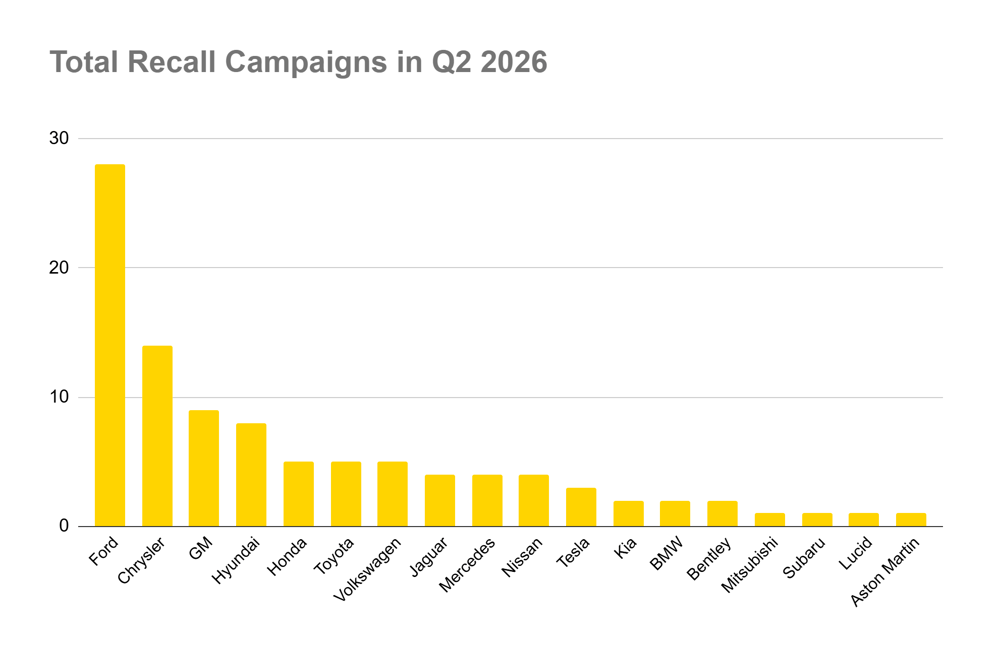
Ford issued the most recall campaigns in Q2 with 28 total, twice as many as the next manufacturer. Together, the top three companies by campaign count (Ford, Chrysler, and General Motors) accounted for more than half of all Q2 recall campaigns.
Q2 2026 Total Recalled Vehicles by Brand
When looking at total vehicles affected rather than campaign count, the rankings shift significantly. General Motors had the third-most recall campaigns in Q2 at nine campaigns but accounted for just 3.2% of recalled vehicles, illustrating how dramatically campaign size can vary.
Honda, by contrast, issued five campaigns but rose to second place by vehicle volume, representing 22.7% of all vehicles recalled. Toyota and Volkswagen also issued five campaigns each, yet both accounted for less than 2% of Q2 recalled vehicles.
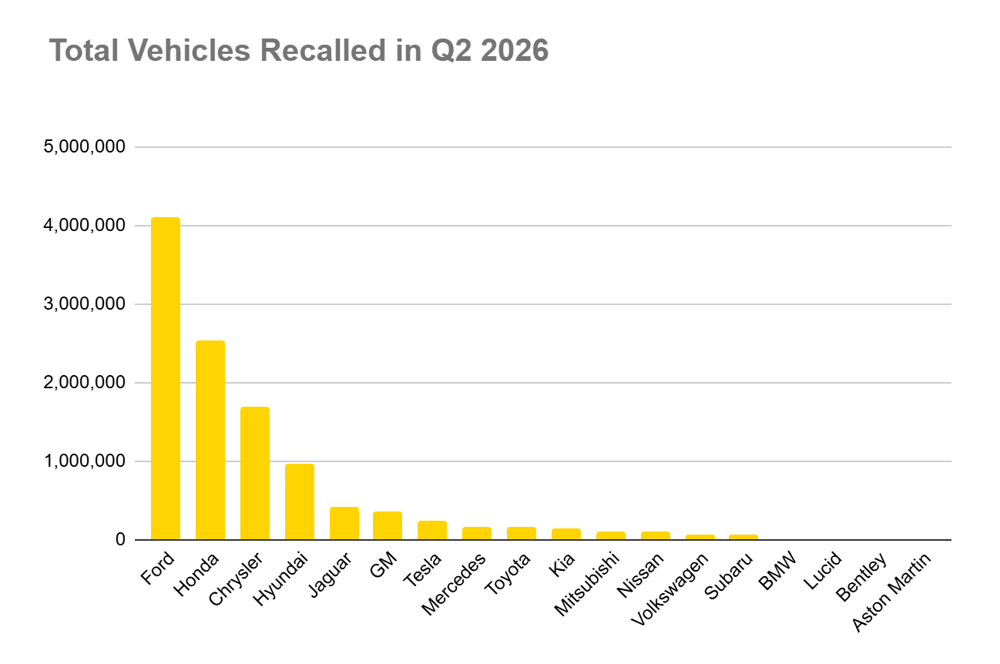
Ford and Honda together accounted for 59.5% of all vehicles recalled in Q2, while the top three brands by volume (Ford, Honda, and Chrysler) represented 74.7% of the quarter’s total.
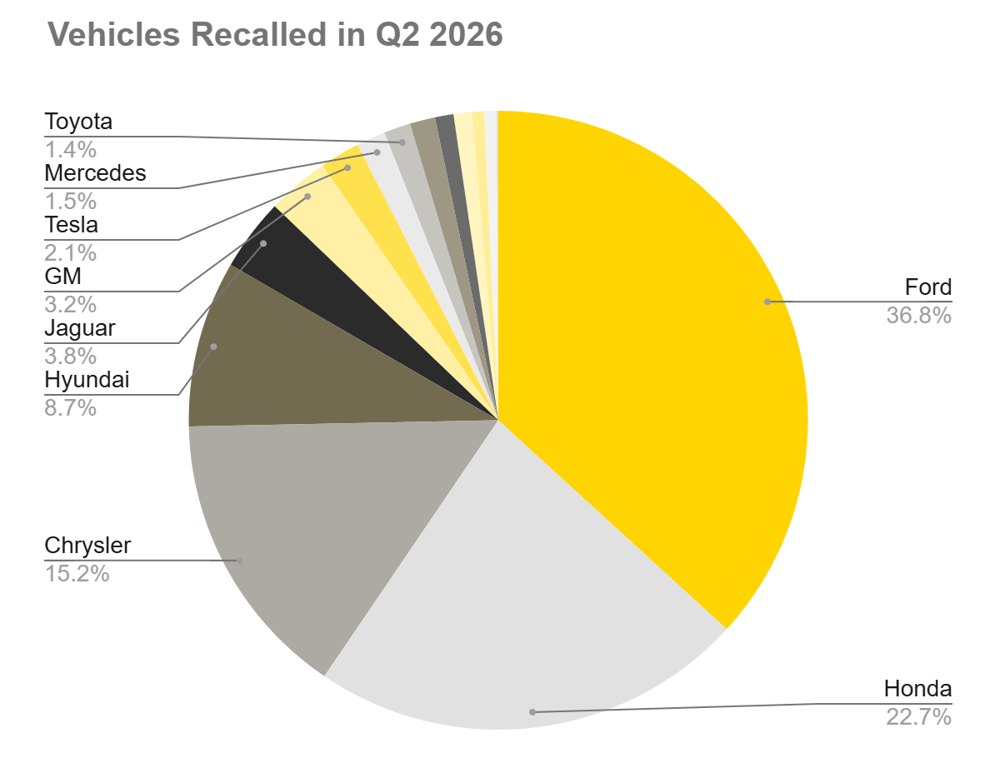
Total Recalled Vehicles and Campaigns by Brand
Ford Continues to Drive Recall Volume in 2026
Ford recall volume declined from Q1’s record-setting pace but remained the largest force in the Q2 recall landscape. It issued 28 recall campaigns in Q2, affecting 4.1 million vehicles and accounting for 36.8% of all vehicles recalled during the quarter.
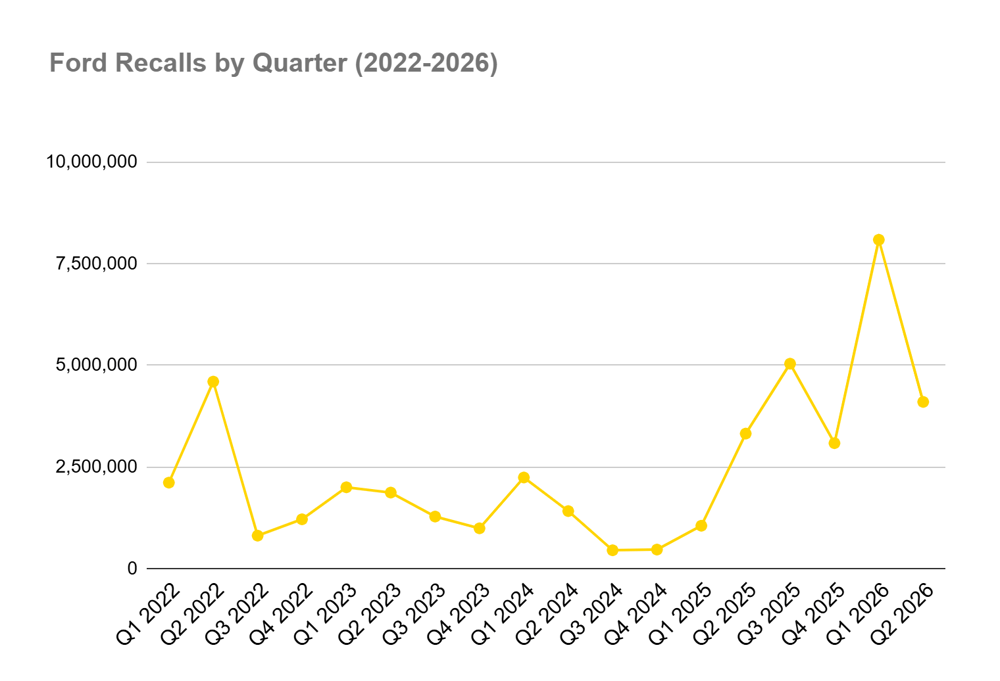
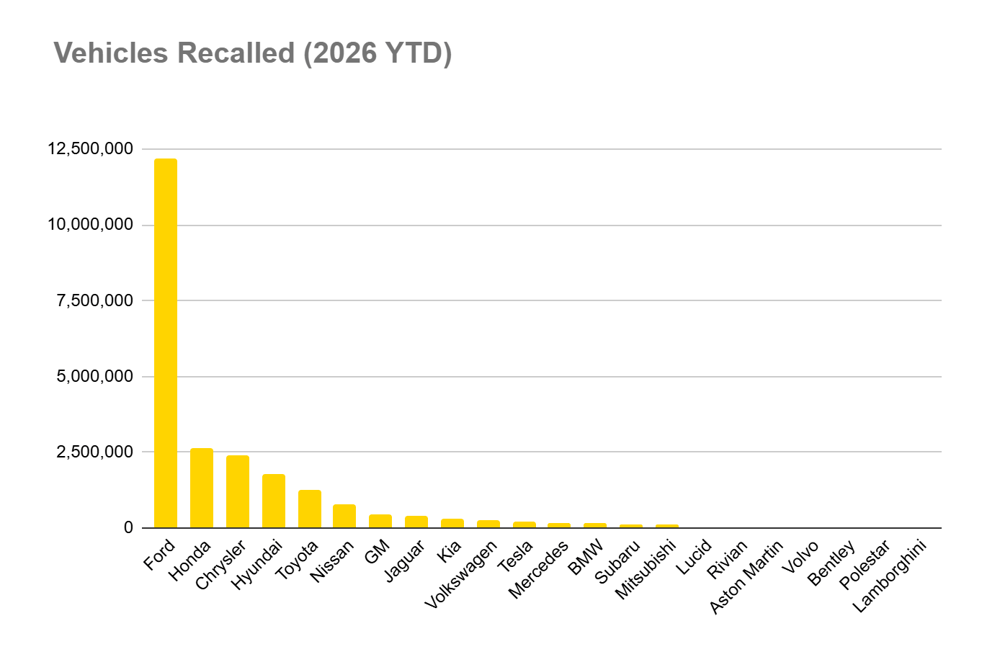
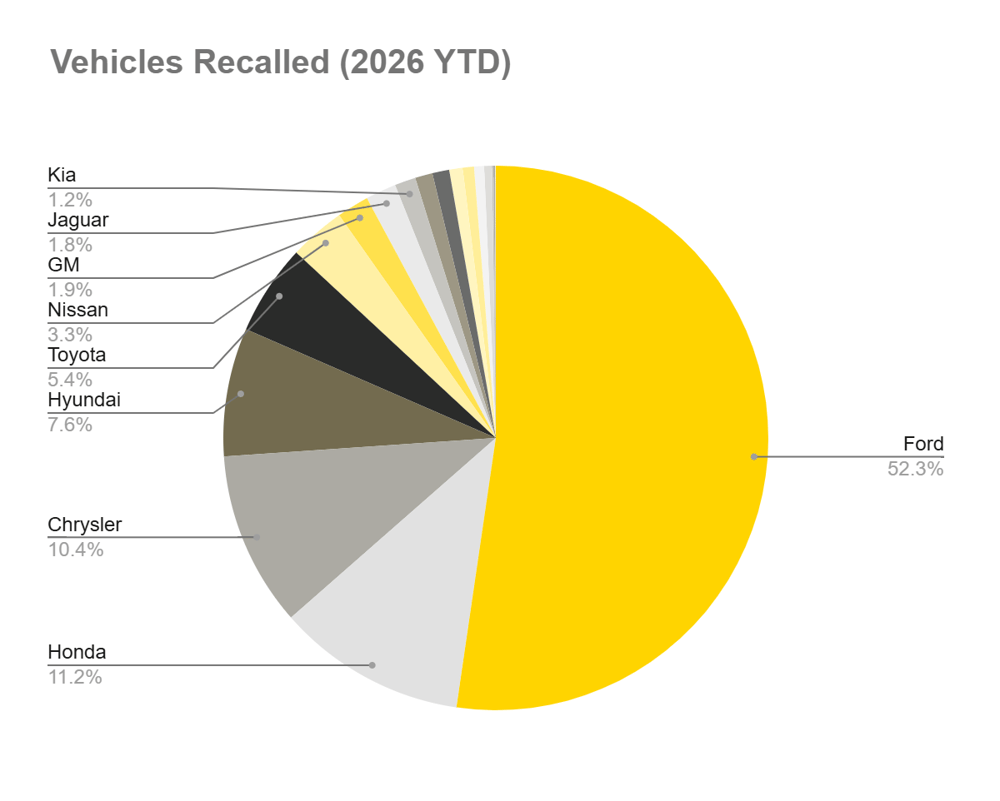
Ford’s lead is even more pronounced across the first half of 2026. The company has recalled more than 12 million vehicles year to date, representing roughly 52% of all vehicles recalled across the industry. While Q2 was less concentrated than Q1, Ford’s continued volume makes it the central driver of recall activity in 2026.
Top Components Recalled in Q2 2026
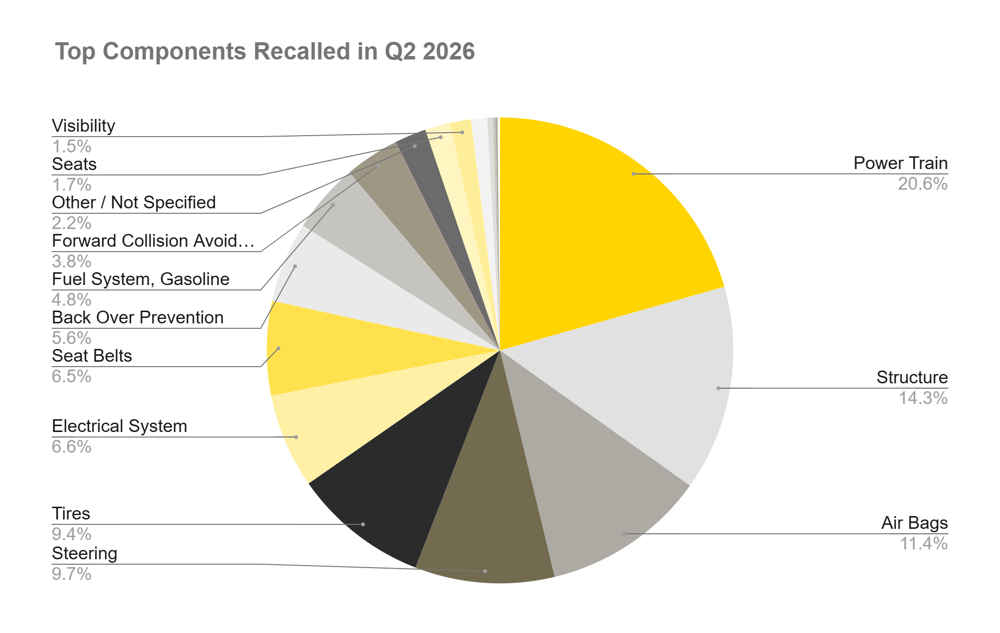
Q2’s component data reflects a broader and more mechanically diverse recall landscape than Q1. Power Train was the leading category, accounting for 20.6% of affected vehicles, followed by Structure, Air Bags, Steering, and Tires.
Together, the top five component categories accounted for roughly two-thirds of all vehicles recalled in Q2. Unlike Q1, when Electrical System and Back Over Prevention issues dominated the quarter, Q2 recall volume was spread across a wider range of safety-critical systems, many of which typically require physical inspection, parts replacement, or in-person repair.
10 Largest Recalls of Q2 2026
Q2 2026 Park Outside and Do Not Drive Advisories
Four recall campaigns carried heightened safety warnings in Q2, affecting a combined 1,098,995 vehicles. Most of that volume came from a single Chrysler campaign involving more than 1 million vehicles.
Park Outside advisories impacted 1,094,276 vehicles:
- Chrysler 21D: Power Steering Wiring Fire Risk (1,076,999 vehicles)
- Chrysler 52D: Battery Fire Risk (17,277 vehicles)
Do Not Drive advisories affected 4,719 vehicles:
- Ford 26S36: Loss of Control from Control Arm Separation (4,653 vehicles)
- General Motors N262557620: Front and/or Rear Wheels May Lock Up (66 vehicles)
These advisories underscore the importance of fast owner identification and outreach when recall risks extend beyond standard repair scheduling.
OTA Updates in Q2 2026
Q2 2026 was notable for the limited role of over-the-air (OTA) software updates. Only five of the quarter’s 99 recall campaigns were identified as OTA-eligible, representing 350,413 vehicles, or just 3.1% of all vehicles recalled. NHTSA also reports that remedies are still under development for two campaigns, accounting for 2.1% of the quarter’s recalled vehicles.
With an overwhelming majority of Q2 recalled vehicles not listed as OTA-addressable, at least 94.8% of recalled vehicles require dealership involvement, physical inspection, dealer-applied software updates, or in-person repair to complete the recall remedy.
Q2’s OTA-eligible recall campaigns:
- Tesla SB-26-00-001: 218,868 vehicles
- Hyundai 304: 96,310 vehicles
- General Motors N252541250: 32,988 vehicles
- Lucid SR-26-05-0: 2,039 vehicles
- Ford 25C69: 208 vehicles
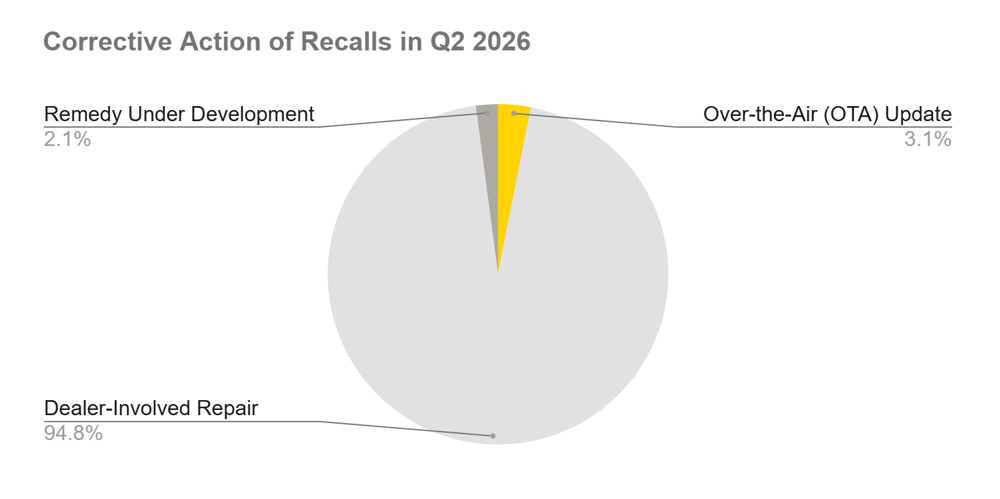
In Q1 2026, nearly half of recalled vehicles were eligible for OTA updates, although that share was driven largely by Ford’s exceptionally large 26C10 campaign. In recent years, OTA-eligible recalls have averaged closer to 15% of recalled vehicles, making Q2’s 3.1% share remarkably low.
Dealership Service Was Central to Q2 Recall Remedies
Q1 2026 showed how a single large software-related campaign can temporarily shift the recall landscape toward OTA eligibility. Q2 showed the opposite side of that reality: in most recall environments, dealership service remains central to recall completion.
With only 3.1% of vehicles recalled in Q2 eligible for OTA fixes, the quarter was overwhelmingly defined by recalls requiring physical inspection, parts replacement, repair, dealer-applied software updates, or service validation. OTA-eligible volume fell by roughly 94% quarter over quarter, from about 5.7 million vehicles in Q1 to just over 350,000 vehicles in Q2.
For dealerships, this makes recall execution a major fixed ops priority. High-volume recall quarters create immediate demand for owner identification, outreach, scheduling, parts coordination, and follow-up. When managed effectively, these campaigns can improve customer safety and create additional opportunities for service retention.
BizzyCar Commentary: What’s Ahead
Q2 2026 shows elevated recall volume continuing beyond the record-setting start of the year. While Q2 came in below Q1’s total, it still ranked as one of the highest-volume quarters in the last several years and helped push first-half 2026 recall activity well above recent norms.
The quarter also showed a different pattern of recall concentration. In Q1, Ford’s 26C10 campaign alone accounted for roughly 36% of all recalled vehicles. In Q2, the largest campaign accounted for about 12.5% of the quarter’s total, with recall volume spread across a broader mix of manufacturers, components, and safety issues. That shift suggests dealerships should prepare not only for occasional mega-campaigns, but also for sustained recall demand across many different repair types.
Looking ahead, recall activity is likely to remain uneven, with high-volume quarters shaped by both software-related defects and physical component issues. Q2’s limited OTA eligibility reinforces that dealerships remain central to recall completion. Dealers that can quickly identify affected vehicles and engage customers proactively will be best positioned to turn recall demand into completed repairs, safer vehicles, and stronger long-term service relationships.
BizzyCar Guidance for Dealers & Drivers
For Dealers
Recalls are one of the most reliable ways to bring customers back into the service lane, and dealers who build fixed ops around them consistently see stronger retention. The challenge is execution. Identifying affected vehicles, reaching owners, and getting them scheduled takes real coordination when it's done by hand. BizzyCar removes that burden by automating the entire outreach cycle, from spotting eligible vehicles to contacting owners and locking in appointments.
That automation translates directly into throughput. Service teams close more repairs with less manual chasing, fewer recall-eligible customers slip through the cracks, and staff spend less time on scheduling logistics and more time working on vehicles.
For Drivers
BizzyCar reminds drivers to address open recalls promptly, not just for themselves, but for their family and everyone else they carry. Most owners don't know their vehicle has an open recall until someone tells them, and even after notification, getting the repair on the calendar often gets pushed off. BizzyCar works with dealerships to flag affected vehicles early, reach owners before the delay sets in, and make booking the repair as simple as replying to a text. Fewer open recalls on the road means safer driving for everyone, and the easier the scheduling, the more owners actually follow through.
To check your vehicle for recalls, use the National Highway Traffic Safety Administration’s recall search tool.
BizzyCar’s Commitment
Every open recall is a chance for a dealership to reconnect with a customer, and BizzyCar is built to make sure that chance doesn't go to waste. As vehicles grow more complex and recall volume climbs with them, our platform keeps dealers ahead of the curve, turning routine recall and service visits into repeat business and lasting customer relationships.
About BizzyCar
BizzyCar is an AI-driven service and recall management platform for auto dealers. It leverages the most accurate recall data available to identify vehicles with open recalls, then uses artificial intelligence and deep DMS integration to engage owners via two-way SMS and proactively schedule recall repair appointments.
BizzyCar Service Engine expands your fixed ops outreach beyond recalls, helping dealerships book appointments for routine maintenance, first service visits, and previously declined work. In addition, BizzyCar supports mobile service operations by powering scheduling, routing, and customer communications, allowing dealerships to meet customers where they are for simpler repairs while preserving shop capacity for more complex work.
Schedule a BizzyCar demo to see how your dealership can turn recall volume into completed service and long-term customer relationships.
All recall data used in this report is from the National Highway Traffic Safety Administration: https://datahub.transportation.gov/Automobiles/NHTSA-Recalls-by-Manufacturer/mu99-t4jn